
Pairing adds value at the margin, contact by contact. Optimized routing delivers financial returns at scale, continuously, across the entire operation.
Closing the Optimisation Gap
The contact center has two distinct optimization problems.
- Routing optimizes the contact center. It manages service levels, queue balance, and agent capacity across the whole operation in real time, continuously and autonomously.
- Pairing optimizes the individual contact. It selects the best available agent for each specific customer at the moment of connection.
Both matter. Neither is sufficient alone. But they are not equal in impact for most operations, and the relationship between them requires careful design. This is not an argument against pairing. It is an argument for getting routing right first, so that pairing has genuine freedom to make high-quality matching decisions.

For the full technical argument, including a detailed review of vendor approaches, the structural limits of pairing, the stateful architecture requirement, the AI agent framework, and the complete operational model, request our White Paper – Pairing and Routing in the Contact Center.
How Real-Time Routing Works
It manages the whole operation, not individual contacts. A real-time optimization engine monitors all queues, all agents, and all channels simultaneously. It reallocates agents autonomously on a worst-first basis: the queue furthest from its SLA target gets priority. No human intervention required.
It responds to demand volatility in milliseconds. Call spikes, staffing shortfalls, and unplanned events are part of the normal operating environment, and the system acts before a supervisor has time to intervene effectively. Inbound and outbound are managed as one. When agents move from outbound to cover inbound pressure, the dialer adjusts automatically.
It requires a stateful architecture. The system must know not just whether an agent is busy, but how long they have been active, when they may become free, and whether they can take additional sessions. Most cloud ACDs are not built to support this level of real-time control. This is an architectural distinction, not simply a feature difference.
It is not workforce management. WFM plans staffing levels based on forecasts. It cannot see, and cannot respond to, what is happening right now. Real-time routing acts on the present. The two are complementary, but they are not the same thing.
It covers all media types. Voice, chat, email, social media, messaging and AI channels are all managed within the same real-time optimization framework.
The AI-to-human handoff is genuinely hard. When an AI session escalates to a live agent, the customer is often already frustrated and needs to reach a human quickly. In a dedicated campaign this can be engineered. In the general inbound case it cannot be pre-positioned, so the cross-pool visibility and real-time queue management enabled by Sytel Real-Time Optimisation (SRO) provide the best chance of a fast, clean connection.
How Pairing Works
- One agent, many customers waiting. The system scans all waiting profiles and selects the best match for the agent who has just freed up. No delay: the agent was taking one of those calls regardless. Pairing ensures it is the right one. This is the dominant scenario in most contact centers, where agents are consistently occupied. The degrees of freedom for pairing are real, but bounded.
- Many agents waiting, one customer arrives. The system profiles the incoming contact instantly and matches it to the best available agent before the call connects. Precise, clean, and unconstrained. This is where pairing has the most to offer, but it is the least common operating condition in most modern contact centers.
Both scenarios need fairness guards. A wait-time escalator prevents customers being indefinitely bypassed. A workload balancer prevents agents being systematically starved. These are the conditions under which pairing operates fairly.
Why Neither Works Alone
Routing without pairing leaves quality on the table. Excellent SLA management connects customers to the next available agent, not necessarily the best one for that contact. The operation runs efficiently, but not as well as it could.
Pairing without effective routing is locally smart but can be globally blind. If the pairing engine draws freely from the agent pool without awareness of SLA pressure, it can starve queues with tight commitments. The operation may look efficient at the interaction level while still missing targets at the system level. Several vendors have acknowledged this tension in their own documentation.
Unconstrained pairing is more than just suboptimal. In a multi-queue environment, it can become seriously damaging to SLA performance. Some vendors have attempted to reconcile this tension by adjusting service level thresholds at the point of each pairing decision, resolving the immediate conflict in the algorithm at the cost of weakening the integrity of the SLA framework. A target that moves to accommodate a routing decision is no longer a target. It is a record of what the system chose to do. That is a workaround, not a solution.
The Right Architecture
Real-time routing governs the operation. It determines, moment to moment, which agents are genuinely free. Pairing works within that space. It does not override it. The routing engine sets the operational conditions. Pairing makes the best use of them.
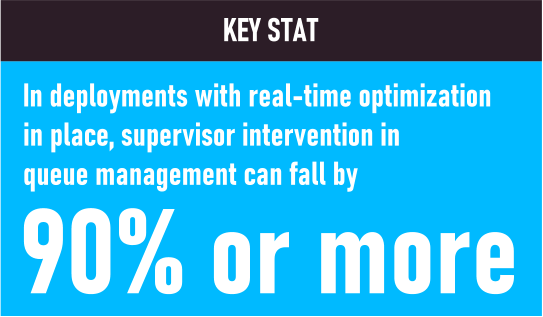
The results are measurable. Supervisor intervention in queue management can fall by 90% or more. Wait times stabilize. Agent utilization improves. And pairing decisions are made from genuine availability rather than artificial scarcity, which improves matching outcomes too.
The balance is a business decision, not a technical one. An outbound sales floor with no contractual SLA may give pairing maximum freedom. A regulated inbound service desk will hold it on a short leash. Every operation configures the balance to reflect its own priorities. There is no universal default.
The two capabilities are complementary. Real-time routing manages the operation as a whole. Pairing optimizes within it. A contact center running both, correctly configured, will consistently outperform one running either alone.
Financial Assessment
Pairing:
Pairing improves top-line performance, making the call more profitable, either through first-call resolution for service or an increased likelihood of a commitment in a sales or collections scenario. In a live contact center environment, however, the operation is more or less always running at capacity. This means that the effective degrees of freedom for pairing are limited. The often-quoted idea of a very high value uplift on every paired call reflects specific, favourable conditions rather than the typical case. In a fully loaded operation, a more realistic expectation is that base revenue might increase by low single digits and not tens of percent. That is a useful uplift, but not a standalone silver bullet.
Routing:
The benefits of optimized routing show up across five areas:
- SLA compliance and penalty avoidance. In regulated or enterprise environments, SLA breaches carry direct financial penalties. Real-time optimization maintains service levels autonomously, eliminating the breach events that generate those costs. For operations with contractual commitments, this alone can represent a substantial and immediate saving.
- Reduced supervisor headcount. Without real-time optimization, supervisors spend the majority of their time firefighting queue problems they cannot fully see or respond to fast enough. With it, queue management is autonomous. Supervisor time in queue management can be reduced by as much as 90%, which is a material cost saving.
- Improved agent productivity. Unmanaged volatility creates alternating periods of overload and idleness. Optimized routing smooths those peaks and troughs, keeping agents consistently occupied at appropriate levels. Higher utilization means more productive output from the same headcount. Lower overload means fewer errors, lower attrition, and reduced recruitment and training costs.
- Better CX and fewer abandoned calls. When inbound queues are managed in real time, customers wait less and reach agents faster. Fewer customers abandon. Every abandoned call that is prevented is a customer interaction that completes rather than fails: a service delivered, a query resolved, or a sale made.
- Revenue protection. Customers who abandon an inbound queue and do not call back represent lost revenue that never appears in any report. It is invisible until it accumulates into churn. Optimized routing reduces that exposure directly, by ensuring that peak demand periods are managed rather than endured.
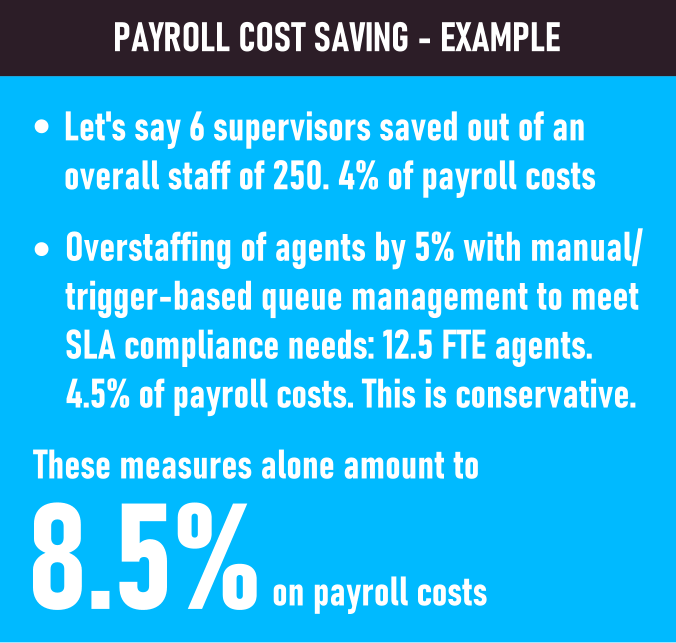
This example, and our views here, reflect discussions with a number of contact center operations, and they represent, in our view, a fair picture of the financial impact in practice. On that basis, the combined positive financial effect of optimized routing across these five areas, when translated into operational cost terms, is likely to be close to , and in many cases exceed, 10% of those costs. This impact can be expected to be substantially greater than the impact of pairing alone in a fully loaded contact center.
The Commercial Opportunity for Platform Vendors
Pairing alone does not differentiate on outcomes. For enterprise customers struggling with service level management, a sophisticated matching engine that still misses SLA targets is not a solution. That customer needs something that works at the system level.
The commercial conversation changes. A platform offering both pairing and real-time optimization stops competing on price and starts competing on outcomes. The question becomes not what does this cost, but what is the cost of not having this capability.
The gap is becoming visible. Vendors whose differentiation rests on pairing, AI agent assist, and CRM integration are increasingly exposed as enterprise customers demand demonstrable operational results rather than feature lists.
For the full technical argument, including a detailed review of vendor approaches, the structural limits of pairing, the stateful architecture requirement, the AI agent framework, and the complete operational model, request our White Paper – Pairing and Routing in the Contact Center.
Learn more about SCC’s modules:
Latest posts

FCC Bombshells

Unlock the True Value of your Predictive Dialer

CCaaS as Value-Added Service – 6 Questions to Ask Vendors

Reinventing the ACD for the Modern Contact Center

Navigating the Evolving CCaaS Landscape: 3 Considerations
